|
The history of Kashmir is defined by
a deep foundation of Hindu-Buddhist culture,
centuries of diverse imperial rule, and its modern status as a deeply
contested, divided, and highly militarized region between India,
Pakistan, and China following the 1947 partition.
-
Ancient & Medieval Eras: From the Mauryan
emperor Ashoka (3rd century BCE) to the Karkota and Utpala dynasties,
the region was a prominent hub of Buddhism and Hindu philosophy.
-
Muslim Rule: Starting in 1346 with the Shah
Mir Sultanate, Kashmir experienced nearly five centuries of Muslim
rule, which saw the deep-rooted integration of Persian culture and
Islam into the region.
-
The Sikh & Dogra Eras: The valley was
annexed by the Sikh Empire in 1819. Later, under the
Treaty of Amritsar,
the British transferred the region to the Dogra dynasty ruler Gulab
Singh in 1846.
-
The Princely State: Until 1947, Kashmir was
a large princely state heavily governed by Hindu monarchs, despite
roughly 77% of its population being Muslim.
The 1947 Partition transformed the region into one of the world's most
enduring geopolitical flashpoints:
-
The 1947 Conflict & Accession: As the
British departed, the state's ruler, Maharaja Hari Singh, delayed
deciding whether to join India or Pakistan. Following an invasion by
armed tribal militias from Pakistan, the Maharaja signed the
Instrument of Accession
in October 1947, which prompted the Indian military to intervene.
-
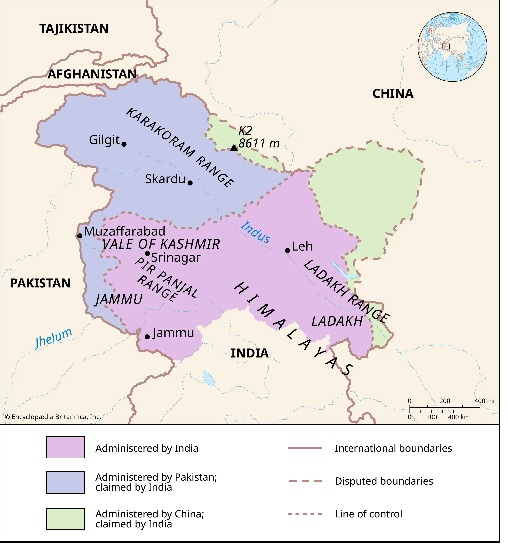
Territorial Division: The war resulted in a
United Nations-brokered ceasefire in 1948 that divided the region.
This line—known as the
Line of Control
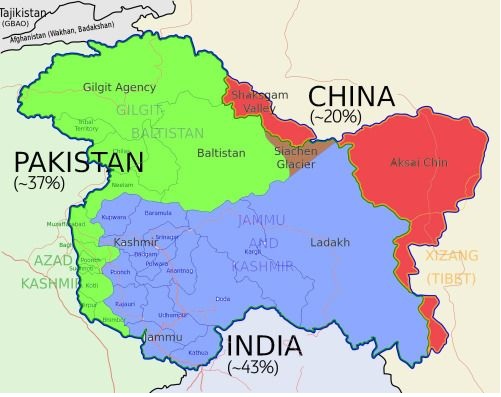
(LoC)—still divides the region into three parts:
-
Indian-administered: The state of Jammu
and Kashmir (and Ladakh).
-
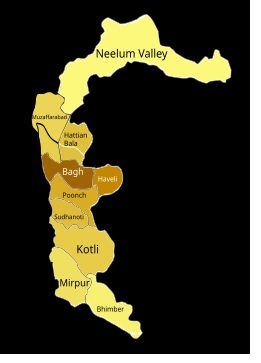
Pakistani-administered: The territories of
Azad Kashmir and Gilgit-Baltistan.
-
Chinese-administered: The regions of Aksai
Chin and the Trans-Karakoram Tract.
-
Ongoing Conflict: India and Pakistan have
fought multiple wars over the territory. The region continues to be a
highly militarized area with complex, long-standing disputes over
sovereignty and local self-determination.
|