|
The history of India is
a continuous, 5,000-year-old continuum
encompassing the entire subcontinent. It evolved
from the ancient Indus Valley Civilization into a mosaic of powerful
regional empires, saw the arrival of Islamic empires and European
colonialism, and culminated in the modern, independent Republic of India.
1. Ancient & Vedic Periods (3300 BCE – 6th Century BCE)
-
Indus Valley Civilization (2600–1900 BCE): One
of the world’s first major urban civilizations, featuring advanced city
planning, plumbing, and extensive trade networks in sites like Harappa
and Mohenjo-Daro.
-
Vedic Age (c. 1500–500 BCE): Marked by the
Indo-Aryan migrations and the composition of the
Vedas. This era laid the foundational framework
for Hinduism and the emergence of the hierarchical caste system.
-
The Rise of Empires: The Ganges region
developed into powerful kingdoms (Mahajanapadas)
which fostered new philosophical movements, including the birth of
Buddhism and Jainism.
2. Classical India (322 BCE – 12th Century CE)
-
Mauryan Empire (322–185 BCE): Unified most of
the subcontinent. Under Emperor Ashoka, who converted to Buddhism after
the bloody Kalinga War, the empire promoted nonviolence and expanded
trade and infrastructure.
-
Gupta Empire (4th–6th Century CE): Widely
regarded as India's "Golden Age". This era witnessed immense
advancements in mathematics (the concept of zero, π), astronomy,
science, literature, and art.
-
Southern Dynasties: Meanwhile, powerful
seafaring and temple-building kingdoms like the
Cholas,
Pandyas, and
Chalukyas dominated the south, expanding their
cultural and trade influence into Southeast Asia.
3. Medieval & Early Modern Eras (12th Century – 18th Century)
-
Delhi Sultanate (1206–1526 CE): Turkic and
Afghan dynasties established an Islamic empire in the north, fusing
Persian and Indian cultures and successfully repelling Mongol invasions.
-
Mughal Empire (1526–1857 CE): Founded by Babur,
the empire reached its zenith under rulers like Akbar the Great (known
for religious pluralism) and Shah Jahan (builder of the Taj Mahal). It
united almost all of India and controlled a vast portion of the global
economy.
4. Colonial Rule (18th Century – 1947 CE)
-
British East India Company: Capitalizing on
the fragmentation of the Mughal Empire, the British East India Company
gained military and administrative control over Bengal, eventually
expanding across the subcontinent through aggressive territorial and
trade policies.
-
The British Raj (1858–1947): Following the
widespread 1857 Indian Rebellion (Sepoy Mutiny), the British Crown took
direct administrative control of India.
-
Independence Movement: Led by figures like
Mahatma Gandhi, the Indian National Congress mounted massive nonviolent
civil disobedience campaigns to dismantle British rule.
5. Independent India (1947 – Present)
-
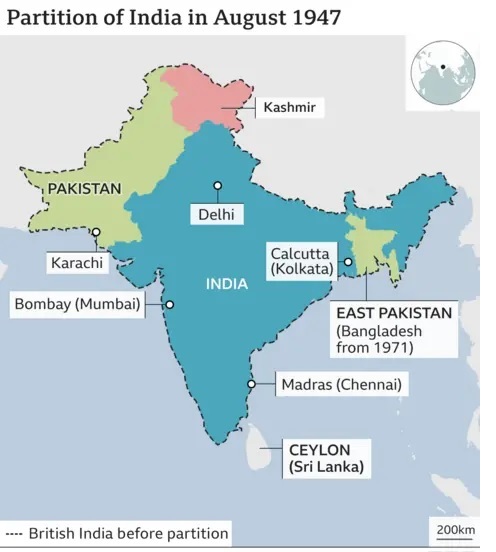
Partition (1947): British India was
partitioned into the independent secular state of India and the
Muslim-majority state of Pakistan, resulting in massive displacement and
communal violence. East Pakistan eventually gained independence to
become Bangladesh in 1971.
-
Modern Republic: Since adopting its
constitution in 1950, India has been the world's largest democracy.
-
Contemporary Status: Following major economic
liberalizations in the 1990s, India transformed into an influential
global player with rapidly growing technology and space sectors.
|